
Crash-Proof EA Templates You Can Use in 2026
Automated trading carries risks, but crash-proof EA templates protect capital and limit losses. These templates...


When the forex market was struck by violent swings and flash crashes in 2025, automated trading—especially bots and expert advisors (EAs)—was put to its ultimate test. While some systems adapted and survived, the majority suffered large losses or shutdowns. What caused so many EAs to fail, and what lessons can traders learn as they prepare for future turmoil?
Most common EAs ran on static rules—optimized for trending or range-bound conditions.
As volatility exploded, these bots kept executing their “old” signals blindly, ignoring liquidity drops and regime shifts. Modern recovery cases show adaptive robots like OXY AI EA MT4 and Dynamic Pips MT4 were able to recalibrate trade size, entry timing, and filters based on real-time signals, echoing volatility frameworks in resources like Investopedia’s volatility guide.
High leverage and poor risk management toppled many bots when price moved quickly against open positions.
This was particularly brutal in grid and martingale systems—like those described in Ultimate Guide to Grid vs Martingale—that kept increasing trade size during losing runs, quickly exhausting equity.
EAs with better drawdown controls, such as WyFX Martingale Pro EA, did far better by capping trade numbers and using emergency pause logic.
EAs running without volatility filters or calendar integration were blindsided by surprise events, thin liquidity, and price gaps.
Bots like Bank Trader VIP MT5 and Arin2 EA MT4 stood out for survival: these monitored event risks and paused trading during major announcements released via the Forex Factory News and Calendar.
For manual traders, following guidance from BabyPips on volatility stops helped sidestep market chaos.
Many EAs—especially budget or “one-click win” robots—were never tested using historic crash data with realistic spreads and slippage.
Research in How to Backtest Your EA for Real Market Crashes demonstrates that only bots trialed with worst-case conditions held up during the real collapse.
EAs like Ultra Breakout EA and FANATIC EA MT4 show the advantage of adaptive grid logic and manual overrides discovered through rigorous testing.
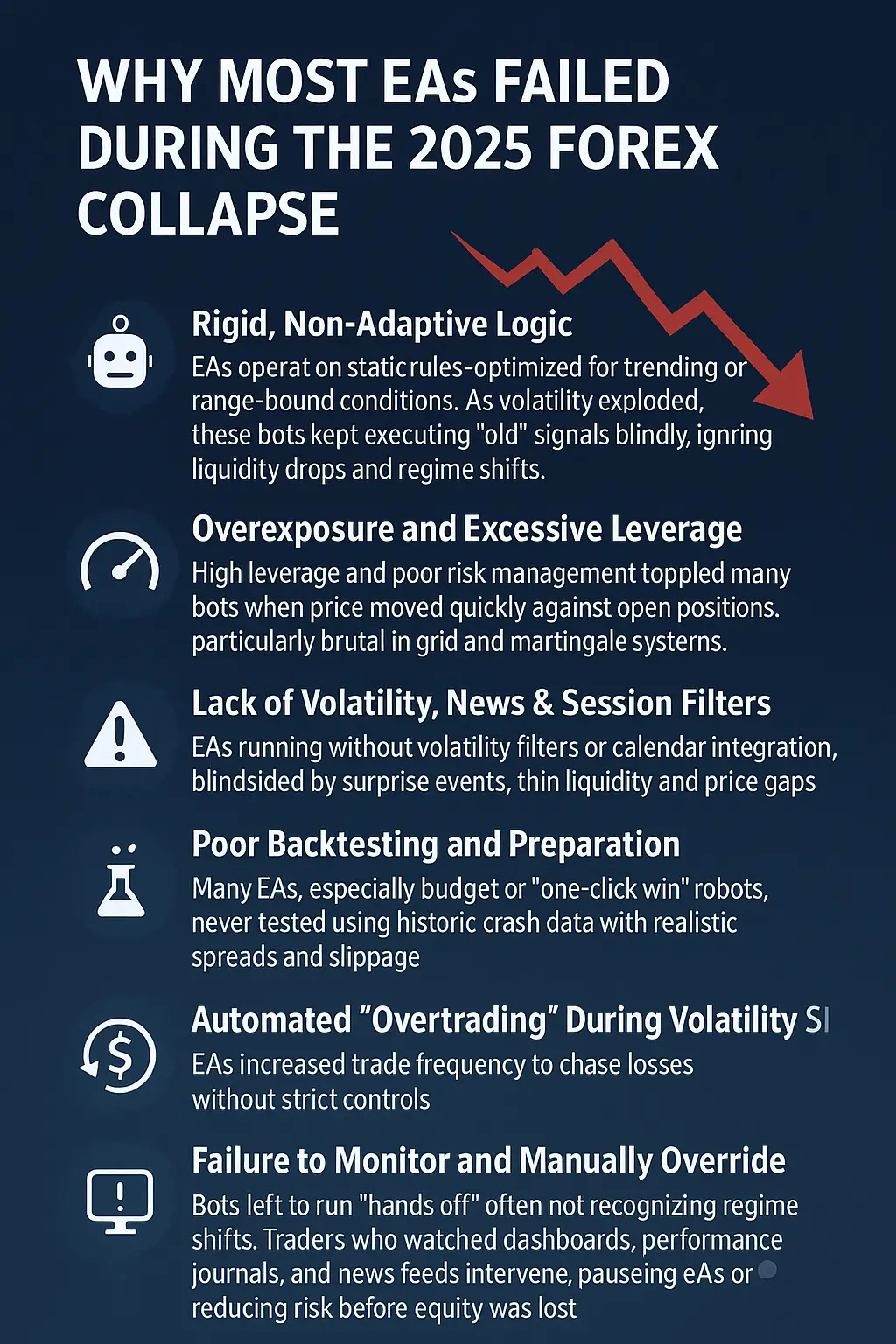
Without strict controls, many EAs increased trade frequency to chase losses, magnifying risk.
Manual journaling, as taught in Ruth the Forex Lady BTMM, plus built-in caps found in smarter bots, let some traders avoid devastating, rapid-fire overtrading.
Bots left to run “hands off” often didn’t recognize regime shifts. Traders who watched dashboards, performance journals, and news feeds (from places like FXStreet) could intervene—pausing EAs or reducing risk before equity was lost.
Can EAs ever be truly crash-resistant?
Only if they incorporate adaptive settings, event detection, risk management, and pass rigorous crash-data backtests. No set-and-forget system is invincible.
Are grid and martingale EAs always dangerous during collapses?
They’re higher risk—unless equipped with equity caps, trade limits, and logic to pause in extreme volatility.
Why did most budget EAs fail in 2025?
Lack of advanced controls, unreliable backtesting, and poor adaptation to fast-changing market conditions sealed their fate.
Is manual trading safer than automation during flash crashes?
Manual trading done with strict discipline and live news monitoring is often safer but more labor-intensive.
In the wake of the 2025 forex collapse, one lesson stands above all: automation alone is never a guarantee of safety or profits. The majority of EAs faltered not because automation is flawed, but because they failed to adapt to fast-changing conditions, lacked real risk controls, and were often based on outdated, rigid strategies. By contrast, the few systems that survived and eventually recovered were elastic—they reduced exposure when volatility surged, paused during news spikes, filtered trades based on live market data, and gave traders the ability to intervene manually.
For traders looking ahead to 2026, true crash resistance comes from combining adaptive logic, thorough backtesting using historic crisis data, and a commitment to proactive monitoring. Whether you use a leading EA, build your own strategy, or trade manually, protecting capital is about more than chasing profits—it’s about expecting the unexpected, preparing for extremes, and refusing to let automation run unchecked.
Ultimately, market turmoil doesn’t just expose weak bots—it separates those who learn, adapt, and improve from those doomed to repeat the past. The greatest edge in tomorrow’s markets will always belong to those who anticipate change, rigorously manage risk, and never stop evolving their approach.
Automated trading carries risks, but crash-proof EA templates protect capital and limit losses. These templates...
Understanding major and minor currency pairs is the first step in forex trading. Understanding major...