
Crash-Proof EA Templates You Can Use in 2026
Automated trading carries risks, but crash-proof EA templates protect capital and limit losses. These templates...


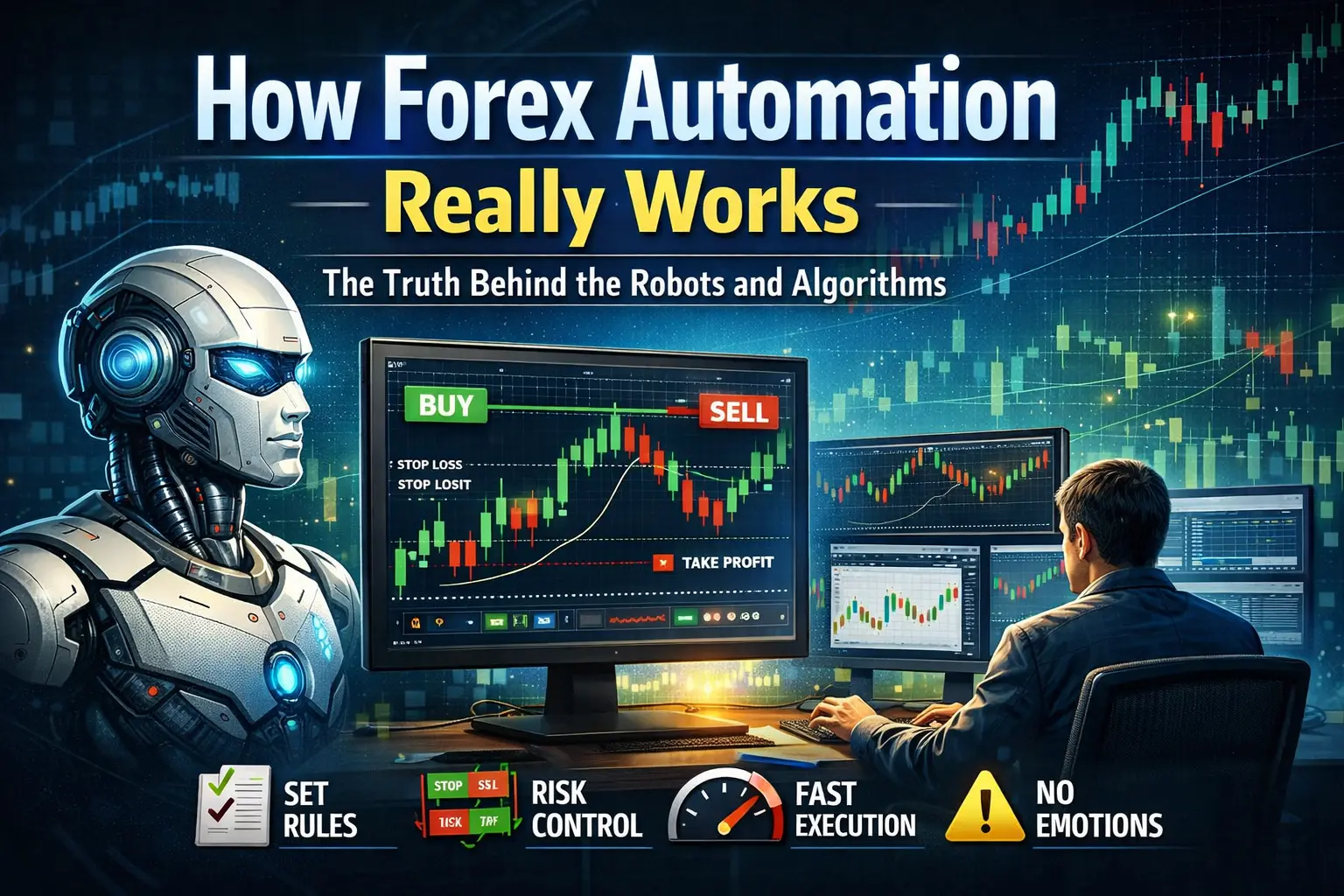
Forex automation is often misunderstood. Many traders imagine automated systems as “set-and-forget” money machines, while others see them as dangerous black boxes that blow accounts overnight. The truth sits in the middle. Forex automation is neither magic nor a scam by default — it is simply a way to execute trading rules consistently, without emotion.
Understanding how forex automation actually works requires separating marketing claims from real trading mechanics.
At its core, forex automation means using software to execute predefined trading rules. These rules are written into an Expert Advisor (EA), script, or algorithm that interacts directly with a trading platform such as MetaTrader 4 or MetaTrader 5.
An automated system does not “think” like a human. It does not predict markets. It simply follows logic.
Typical automated rules include:
If those rules are flawed, automation only executes them faster and more consistently — it does not fix them.
For a foundational explanation of automated trading concepts, Investopedia provides a clear overview of algorithmic trading and its mechanics .
A forex robot follows a structured flow every time price updates:
First, market data is read. This includes price, spread, volume (if available), time, and indicator values.
Second, the EA checks conditions. For example, it may ask:
Third, if conditions match the rule set, the EA sends an order to the broker.
Fourth, risk controls are applied — lot size, stop loss, and take profit are calculated automatically.
Finally, the EA monitors the trade until exit conditions are met.
There is no intuition involved. Every action is rule-driven.
Automation excels at discipline. It never hesitates, never overtrades out of boredom, and never breaks rules due to fear or greed. This is why many professional traders automate at least part of their execution.
However, automation struggles when:
The Bank for International Settlements has repeatedly highlighted that algorithmic systems amplify both discipline and risk depending on how they are designed and monitored .
Automation removes emotional mistakes, but it cannot remove structural strategy flaws.
Not all EAs work the same way. Understanding their structure matters more than brand names.
Trend-based systems trade only in the direction of a confirmed trend and usually trade less frequently.
Breakout systems wait for price to escape consolidation zones.
Scalping systems aim for small, frequent profits under strict conditions.
Recovery or grid systems attempt to offset losses through position management, often increasing exposure.
Each logic type behaves very differently during volatility, news events, and long trends.
Most failures come from misuse, not from automation itself.
Common reasons include:
According to research published by CFA Institute, over-optimized systems often perform well in historical testing but degrade quickly in live markets when conditions shift .
Automation requires supervision, not blind trust.
To make the concept concrete, it helps to look at real automation styles used by traders today.
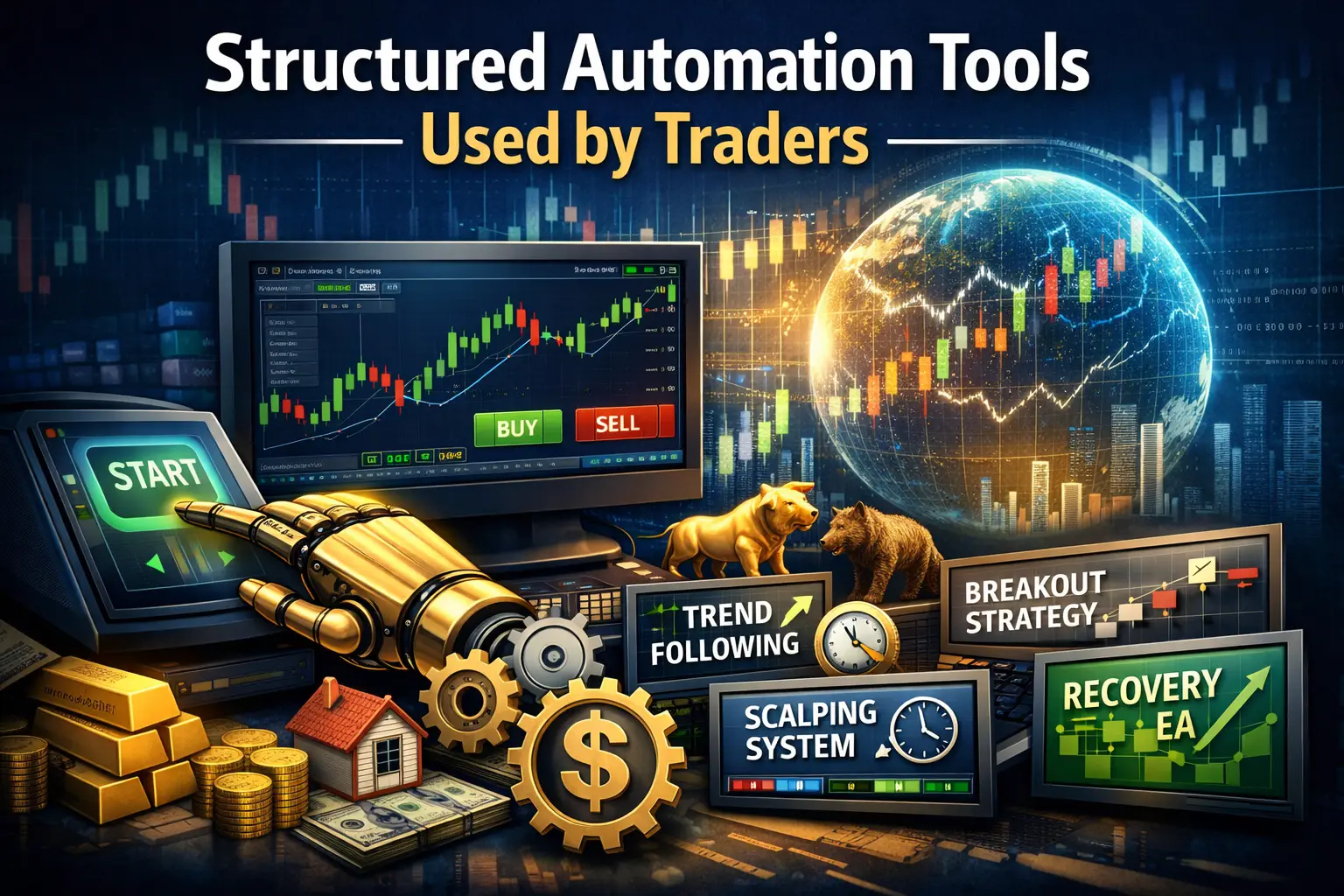
Some automated tools focus on risk control, others on execution discipline, and some on specific market behavior. The following examples illustrate different automation approaches rather than promising outcomes.
AW Recovery EA v3.3 uses controlled recovery logic with predefined limits, designed to manage drawdowns rather than endlessly increasing exposure.
Money Gold EA v1.0 MT4 applies structured logic specifically to gold markets, where volatility and session timing play a larger role than in major currency pairs.
Polygon Forex Scalper MT4 focuses on filtered scalping, entering trades only when spread, timing, and price behavior align within narrow parameters.
50 Pips a Day MT4 represents a target-based automation style, built around capturing a defined daily range rather than constant market exposure.
Each of these tools reflects a different philosophy of automation — none replace risk management or market awareness.
Manual trading relies on human judgment, which can adapt quickly but is inconsistent. Automation relies on consistency, which can struggle during regime changes.
Many experienced traders use hybrid approaches, automating execution while manually controlling:
This balance often produces more stable results than full automation or full discretion alone.
Automation cannot:
Regulatory bodies such as the U.S. Commodity Futures Trading Commission consistently warn that automated trading still carries full market risk and requires trader responsibility .
Any system claiming otherwise should be questioned.
Responsible automation starts with realistic goals.
Key principles include:
Automation works best as part of a broader trading plan, not as a shortcut.
What is forex automation in simple terms?
Forex automation uses software, called Expert Advisors or trading bots, to place and manage trades based on predefined rules. These rules come from strategies like trends, breakouts, or volatility filters, not emotions or guesses.
Do automated trading systems guarantee profits?
No. Automation does not remove risk. It only removes emotional decision-making. Profits still depend on market conditions, strategy quality, and proper risk management. A bad strategy automated will still lose money.
How do forex robots actually make decisions?
Forex robots follow coded logic such as indicator signals, price action conditions, time filters, and risk rules. They do not “think” or predict the market. They react strictly to what the rules allow at that moment.
Why do some forex EAs stop working over time?
Markets change. Volatility, trends, spreads, and liquidity evolve. An EA built for one market phase may struggle in another if it lacks adaptive logic or proper updates and optimization.
Is manual monitoring still needed with automated trading?
Yes. Traders should still monitor performance, update settings, manage risk, and stop systems during abnormal conditions like major news events or platform issues. Automation helps execution, not responsibility.
Forex automation is neither hype nor deception — it is simply structured execution. When built on sound logic, controlled risk, and realistic expectations, automation can remove emotional mistakes and improve consistency. When misunderstood or misused, it amplifies losses just as efficiently as it executes trades.
Understanding how forex automation really works allows traders to evaluate systems critically, choose tools intelligently, and use technology as support rather than blind dependence.
Automated trading carries risks, but crash-proof EA templates protect capital and limit losses. These templates...
Understanding major and minor currency pairs is the first step in forex trading. Understanding major...